According to the report released by the Chinese Sturgeon Research Institution of China Three Gorges Corporation, the technical difficulties of the ‘final step’ to the Chinese sturgeons of artificial reproduction have been solved. It marks the breakthrough in this area and the completeness of the system of artificial reproduction, for at least technically speaking, we would prevent this old rare species from extinction in this planet.
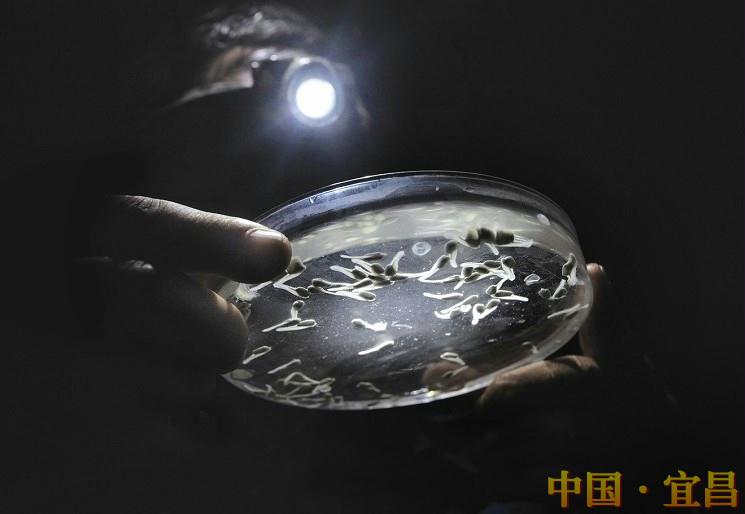
The Chinese Sturgeon Babies (Photo /Liu Kang)
After 96 hours, second-filial-generation baby sturgeons were born.
At 18:40 of November 1, researchers successfully implemented artificial reproduction and spawning-inducing for sturgeons, getting 150,000 ova which were fertilized later on at the research base of Chinese Sturgeon Institution located in Three Gorges Dam Area. At 10:00 on the morning of November 5 , the first fry was out of spawns, and a total of 20,000 Chinese sturgeons were born by 11:00 of November 6.
At 10:00 on the morning of November 6 , in the conservation workshop of Chinese Sturgeon Institution, reporter saw a great many of sturgeon ova like black beans being uniformly put in more than 10 incubators installed automatic circulating water devices. With the current, the fish fries were continuously out of spawns. There were some spawned juvenile fishes swimming like tadpoles on the surface of the water which are also called second-filial-generation.
These babies’ mother, number 6D22, was born with artificial reproduction in 1996, named “Xiaoliu”; their father, number 5FD8, was born in Chinese Sturgeon Institution, named “Xiaowu”. Both of them were gave the birth by wild Chinese sturgeons and matured in 2010 and 2011 respectively when they had babies for the first time. And these baby sturgeons are their second children through artificial reproduction and spawning-inducing.
From November 1, nursery governesses of Chinese sturgeons were continuously nervous and excited, and Jiang Hua, Director of Breeding Center of Chinese Sturgeon Research Institute, stayed up the whole night to keep these babies.
At 19:20 of November 1
Closely monitored by researchers from September, the first-filial-generation mother sturgeon appeared ovulation signal, and “Chinese sturgeon midwives” started to artificially help her to ovulate.
At 20:00 of November 1
After 40 minutes of ovulation, researchers totally got 150,000 roes and then fertilized them with the success rate of fertilization reaching to 78 percent. Then, all fertilized ova were delivered into incubators in an hour.
On November 4
About 60 hours later, fertilized ova appeared blastokinesis-in 2mm-diameter fertilized ova, baby sturgeons with big tummy and long tail were struggling. According to statistics, fertilized ova appearing blastokinesis amounts for 68 percent of total ova, which reach the natural reproduction level of Chinese Sturgeons.
At 6 PM of November 5
With the increase of motion frequency, motion range getting increasingly wide, by November 6 came the most exciting moment that 80,000 to 100,000 fry of artificial reproduction burst from the eggs, roughly 96 hours after the fertilization. Guo Bafu, the Director of the Species Conservation Lab of Chinese Sturgeon Research Institution of China TG Corporation, says that the fry will be moved to the temporary feeding pool and able to begin food intake after 10 days.
Three Generation of Chinese Sturgeons, Different Ways of Breeding
As for the artificial reproduction of the Chinese Sturgeon, the second generation seems to be more fortunate than the first. In 2000 the second generation of the Chinese Sturgeons were born, which marked the success of the technology of the laparoscopic ovum pick-up applied to the living Chinese Sturgeons without trauma. Because of this achievement, a wild Chinese Sturgeon miraculously survived after giving birth to the first batch of offspring with the help of artificial technology. Then this wild Chinese Sturgeon was released to the Yangtze River after recovery.
Despite Artificial Reproduction, DNA Unchanged.
And Gao Yong, Deputy Director of Chinese Sturgeon Research Institution, points out that the Chinese sturgeon is characterized by its adaptability to the environment.
As one of the oldest rare species on earth and a kind of old rare fish unique to China, living on earth for 140 million years, the Chinese sturgeon is honored as the ‘living fossil’ . As early as the Ming Dynasty, although the main stream of the Yangtze River was intercepted for 38 years because of the dike breaching in the section of Zigui, Chinese sturgeon was not extinct. And when the Yangtze was enclosed by the Gezhouba Dam in 1981, their spawning sites were found one year later in the downstream of the dam, in which they continued to breed until now.
But to what extent do these Chinese sturgeons of artificial reproduction share the characteristics of their ancestors? Though not bred in the wild environment, the second and the third ones of artificial reproduction are not strange to the marine environment. The experiment that was done at the Institute also proved that. In this experiment, researchers gradually increased the fresh water’s salinity and these artificial fish were still used to the marine enviroment.
The artificial releasing started since the successful artificial reproduction of Chinese sturgeon at Institute of Chinese Sturgeons. Since then, over 5 million fry have been successively released to the Yangtze River.
On February 28, 2013, one Chinese sturgeon was accidentally caught by the fisherman in the outer sea of Jinqimen Village of Hepu Township, Xiangshan County, Zhejiang Province. It was confirmed later that that sturgeon was released in the section of Yichang in 2012. On July 23, 2013, another Chinese sturgeon was accidentally caught by the fisherman at the water area of Yanggang of Balijiang section of Yangtze River in Hukou County of Jiangxi Province. It was confirmed later that the sturgeon was also released in the section of Yichang in 2013. “It proves that the Chinese sturgeon of artificial reproduction is capable of migrating into the sea”, says Gao Yong. He holds that in spite of artificial reproduction, the second and the third generation of Chinese sturgeons of artificial reproduction as well as their offsprings can keep their DNA that inherited from their wild ancestors and original life habits.
It’s said that during the process of artificial reproduction of Chinese sturgeons, the experiments in terms of ultra-low temperature frozen sperm and embryonic cell breeding are also conducted which will lay the solid foundation for the construction of genomics of the Chinese sturgeon and the genetic resources center.
Although comprehensive technology system of artificial reproduction of Chinese sturgeon has been set up, the experts suggest that it should be fundamental to improve the water environment of the Yangtze River and to crack down on the illegal fishing activities to protect Chinese sturgeons. (Reporter Zhang Yuanyuan, Correspondents Wang Donghong, Xie Ze)