Concerted efforts being made to improve growth, pursue high-quality development
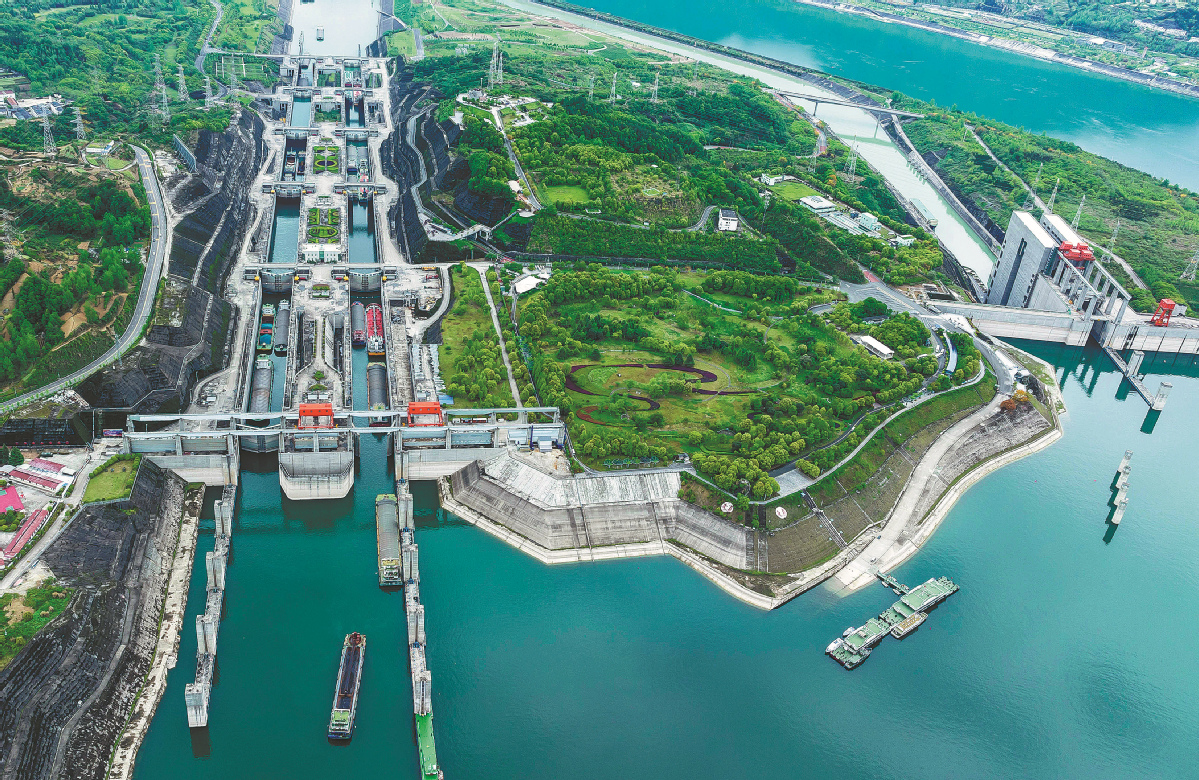
Ships pass through a lock on the Three Gorges Dam in April. The dam's annual freight volume has surpassed 100 million metric tons for the past five years. ZHENG JIAYU/XINHUA
A row of buildings stands in the background as the sun blazes down on neat roads alongside lush lawns and newly planted saplings anchored to the ground by wooden supports.
At first sight, this appears to be just another typical newly built office compound that can be seen in many areas of China. But staff members wearing safety vests and helmets, a chimney emitting white smoke and pipelines rising high into the air serve to remind visitors that they have entered a chemical factory.
Located in the Yaojiagang Chemical Industrial Park in Zhijiang, Yichang city, Hubei province, the factory is a production base for local enterprise Hubei Sanning Chemical Industry Co.
The base, which can produce 600,000 metric tons of ethylene glycol a year, is supported by smart technologies, including 5G. Ethylene glycol is used as an antifreeze, and in the manufacture of polyester.
Yang Wenhua, an employee at the company who led the establishment of the smart system, said that with the help of such technologies, the factory has significantly improved the safety and efficiency of production.
The smart system also helps reduce the amount of harmful byproducts formed — making the entire manufacturing process more environmentally friendly, Yang said.
The company is one of 108 operating at the industrial park, which was established in 2008.
Xia Kesong, director of the Zhijiang high-tech zone management committee, which oversees the park, said most companies operating there used to focus on manufacturing chemical fertilizers.
Now, they have expanded to sectors such as new materials and biomedicine, Xia said.
The park boasts a sound supply chain, as products and even byproducts made by some companies are raw materials for others. This, in turn, reduces logistics and treatment costs, Xia said.
The park is planning to attract more high-quality and competitive companies.
"We run a strict review of companies which want to do business at the park, to assess five aspects — their safety, environmental friendliness, energy consumption, profits and investment," Xia said, adding that the park has rejected many unqualified candidates.
Development of the park serves as a vivid example of how Yichang, a city on the Yangtze River that used to rely heavily on the chemical industry, is upgrading this industry and reducing its impact on the environment.
President Xi Jinping has emphasized on different occasions the importance of protecting the Yangtze River.
At a symposium in Chongqing in 2016 on improving development of the Yangtze River Economic Belt, Xi stressed that this is an overwhelmingly important task to restore the river's ecology and the environment.
Two years later, during an inspection visit to Hubei in 2018, Xi said in Yichang that the economic belt should be developed in a scientific and orderly manner, and this development must not undermine the environment.
Inspired by Xi's words, the authorities in Yichang launched strenuous efforts to improve the environment of the Yangtze.
More than 130 chemical companies located within 1 kilometer of the river have been closed or relocated, while stringent measures have been taken to ensure wastewater is properly treated.
Chen Xiaoqing, assistant general manager of Xingfa Group, a local chemical company, said the factory has closed its wastewater outlets into the Yangtze. The wastewater is now sent to a government-built sewage treatment plant.
Before being accepted by the plant, the wastewater must be treated according to government requirements, which Chen said are "very high".
Chen said that to meet these requirements, the company spent a large amount on upgrading its equipment.
This was a "rather painful" process at first, but now the company's "greatest core competency" is the ability to reduce its environmental impact, Chen added.
The story of Yichang, located in western Hubei, illustrates the efforts made by the authorities to improve the province's growth pattern and pursue high-quality development.
Hubei Daily reported that earlier this year, Hubei issued a guideline to further advance its chemical industry.
The provincial government said in the guideline that chemical companies in the province should manufacture high-quality raw materials, and work to overcome technical challenges to provide high-end products and those that are in short supply.
It is strictly forbidden to set up chemical industrial parks in places such as nature reserves, source water conservation areas, and areas within 1 km of the Yangtze River, the government said.
The government also issued a three-year action plan to improve safety at chemical industrial parks in the province.