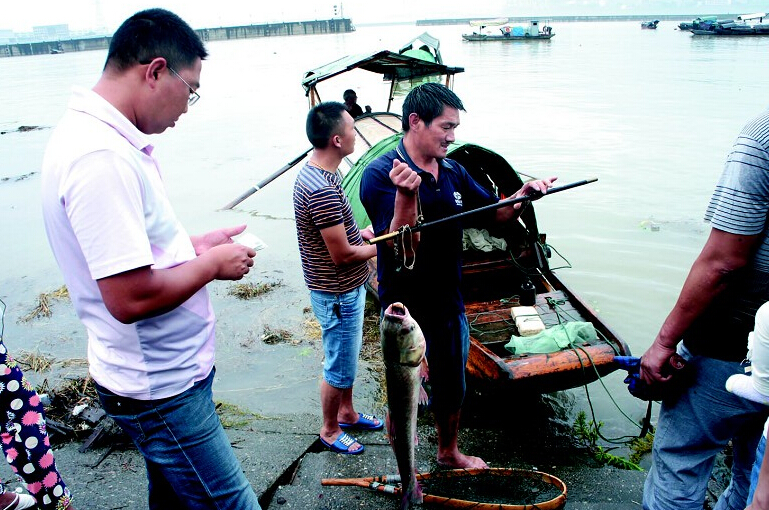
Fishermen are selling fish to people at Ziyang Wharf. (Photographed by reporter Zhong Liang)
After 3-month “fishing moratorium” period, fishing ban in the Gezhouba Dam downstream of the Yangtze River in Yichang Section was officially lifted at noon on June 30, and more than two hundred anchored fishing boats set their sail into the river to start their first “fishing”.
“We are waiting for this day during the long fishing-ban period.”
At 10 am, despite the strong wind and heavy rain, Ziyang wharf turned out to be a busy scene in this first fishing day. Wang Bangjun worked together with his brother dragging out their three fishing boats, preparing for fishing, including refueling, refilling water and ice, pulling anchor ropes on the shore and the new-mended fishing nets back into the fishing boat. Afterwards, they two stood separately in the boat’s two ends and prepared to set off.
At 12pm sharp, after the Fishery Administration lifted the ban, all fishing boats could not wait to start their engines and drove off the wharf. The spring fishing ban period for the Yangtze River of the Yichang section started from February 1 to June 30, which involves an area of the 232 km long between the Yangtze River upstream and downstream. To be specific, the fishing ban for the upper part of Gezhouba dam started from February 1 to April 30, mainly including Qianping Village; the lower part of the dam started from the month of April to June 30, mainly including Ziyang, Sanjiang, Shilihong, Aijiazui, and Qiaohe Area. “We are waiting for this day during the long fishing ban period.” Wang Bangjun, a now 50-year-old man, said so. He started fishing since he was 29, so he had a special attachment to the Yangtze River. He lives on fishing in the Yangtze River. With the previous fishing experience, the fishermen began their “seeking for luck” tour.
"The illegal fishing by electrical shock is extremely devastating because many young fishes were killed by it."
Wang cast net for 30 times within two hours, and “designed many traps” under different anchor ropes and the buoys. The large opened square net was like a big umbrella. As Wang put it, “In this season, we can only catch the four major types of Chinese carps.” The two main fishing methods were using large square net and net fishing. “The net fishing is to lower the net into the river and waiting for the fish going inside; the large square net is to drive the large boat to find fish by oneself along the flowing river.”
The clouds were very low above the river and the fishing boats were waving from side to side constantly. Wang’s brother, having started fishing since he was 16 years old, had already become accustomed to the stormy waves, and also had a good estimation about his caught.
The implementation of “fishing moratorium period” is a fish resources protection system practiced around the world, which aims to protect the normal growth and reproduction of aquatic creatures. However, the frequent illegal electrical shock fishing has done great harm to fishing resources. “Many young fish were pitifully killed.” The relevant person in charge in the Municipal Fishery Administration said. This year Yichang dealt with 59 cases of illegal fishing in the Yangtze River, 19 of which were related to the electrical shock. The fishery watchdogs have confiscated 5 weapons called “maze gap confiscation and destruction”, 35 net tools used during fishing-ban period, and 35 sets of various electric fishing tools. They handed over 16 criminal cases involving 34 people to the Public Security Department.
The fishing income has been declining yearly, and the return with a full boat fish is difficult to be seen.
As the saying goes, there are three bitter things in the world: punting, striking iron and grinding bean curd. Mr Qin, now 32 years old, is the youngest fisherman in Ziyang. Ever since the day the fishing ban was lifted, he has spent his life in the fishing boat. Qin was reluctant to part with his wife and his 9-month baby. When being asked, “Have you had any thought about a career change?” he shook his head, and answered, “What else can I do except for fishing?” At present, the fishermen at Ziyang wharf are from more than 20 households with an average age of over 40 years old. They generally did not have a high level of education, and fishing is the only “skill” they possessed. The fishermen said, “The fishing income has become worse and worse year after year. We can earn 60,000 to 70,000 yuan in good times, but only 10,000 yuan in bad times. ”
When the night was approaching, the fishing boats drove back to the wharf in succession. The five over-five-kilo silver carps caught by Wang Bangjun were purchased one after another by people who had been waiting for the “fresh fish” at the wharf. Having seen the good market, the fishermen’s regained their confidence. The delightful scene that “People set sail to the sea with nets and came back with lots of fish.” is not to be seen, but the first try in the morning gave fishermen great hope. (Reporter: Li Yuxian; correspondent: Mo Hongyuan)